
Pickleball's Hidden Risks
America’s fastest-growing sport brings joy to millions—especially seniors. But are we ignoring the risks?

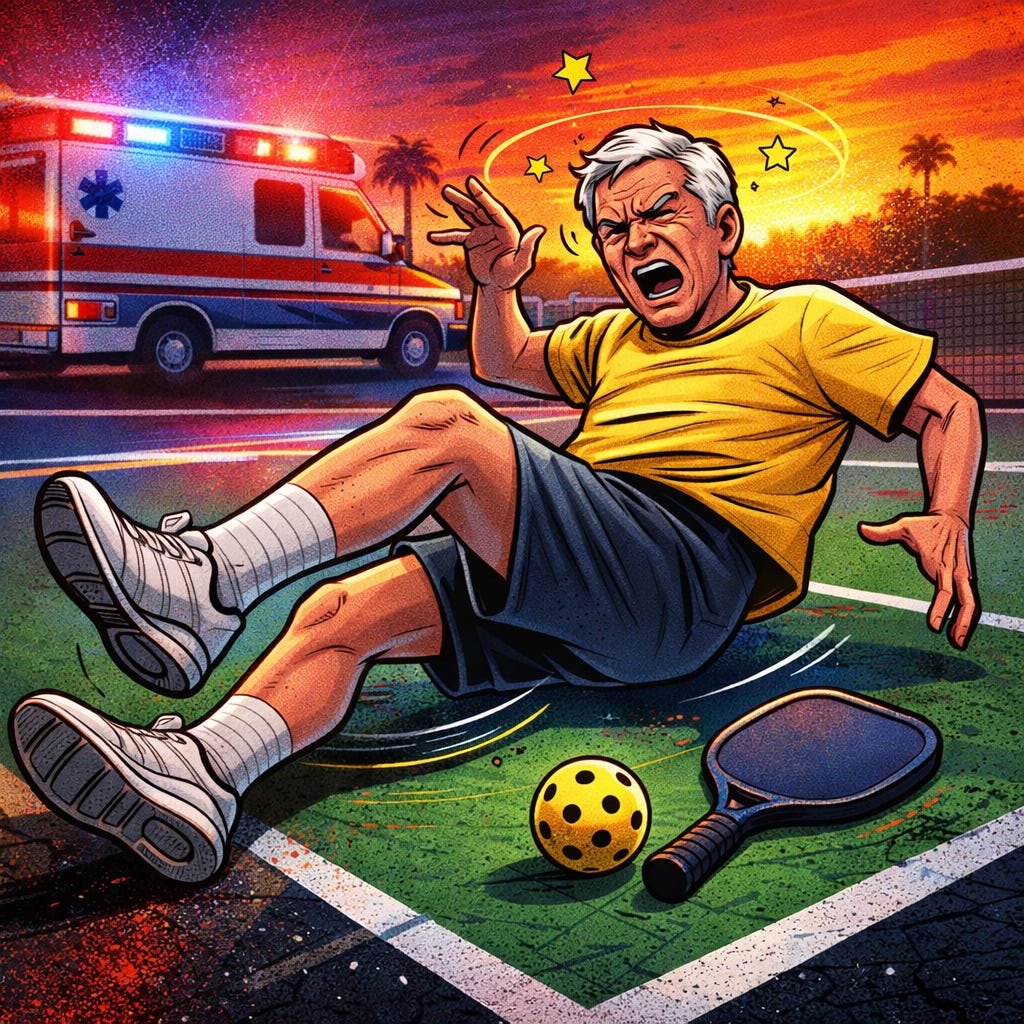
Pickleball is everywhere. Indoors. Outdoors. At public parks. At country clubs and retirement communities across the country. It has exploded in popularity—especially among seniors looking for activity, competition, and community. For the most part, it delivers exactly that.
Fun.
Social connection.
Exercise.
As the sport grows in popularity, a problem is developing with some alarming regularity:
People are getting hurt.
Some people are getting seriously hurt.
When “Fun” Turns Dangerous
Recently, Jeff Webb (76 yrs old), an influential cheerleading entrepreneur who founded Varsity Spirit, died following a head injury suffered during a pickleball game.
Closer to home, in my own South Florida community, a friend of mine suffered a fractured hip—requiring surgery. Others? Wrist fractures. Shoulder injuries.
Falls that don’t just bruise—but change lives.
For younger players, a fall might mean a few weeks off. For seniors in their 70s, 80s—even 90s? It could mean the loss of independence.
The Problem Isn’t the Game—It’s the Conditions
Pickleball itself isn’t reckless.
But the way it’s commonly played—especially by older players—creates real risk:
Hard surfaces (concrete/asphalt) → unforgiving on impact
Quick lateral or backwards movement → easy to lose balance
Fast net play → face and head exposure
Slightly wet courts → dangerously slippery
Add in reduced bone density and slower reaction time and the margin for error disappears.
Safer Options We’re Just Not Using
Here’s the part that concern me:
Safer alternatives already exist. Most venues just aren’t proritizing them.
Currently available:
Cushioned courts with shock-absorbing layers
Indoor sport courts (wood or composite)
Clay-style surfaces—long used in tennis—are more forgiving on falls
Yet most pickleball is still played on hard concrete, the least forgiving option available. So far, the game demands that seniors play a fast-moving sport on surfaces that were never designed to forgive a fall.
Safer Balls:
Not all pickleballs are the same.
Outdoor balls (most common): hard plastic, fast, high impact
Indoor balls: softer, slower, more forgiving
Foam or “quiet” balls: significantly reduced impact, ideal for seniors
Unfortunately, most venues default to the hardest, fastest ball available, that yellow or orange “whiffle” ball.
A Sport Built for Accessibility—Now Pushing Its Limits
Pickleball’s appeal, especially to seniors looking to remain active, is that it’s easy to start. But with easy accessibility, there are other hidden risks:
Players often jump in without fully appreciating how physically demanding and unforgiving the game can become. And what starts as casual quickly becomes competitive. Here in South Florida, there are competitive senior leagues and championship competition. And pickleball isn’t just growing—it’s taking over.
Tennis courts are being converted. Tennis programs are shrinking. Players with less mobility are switching to pickleball. While tennis—especially on natural clay—offers a more forgiving environment, pickleball, at least for now, seems to be winning the popularity contest.
I play pickleball. I enjoy pickleball. I’m not advocating that clubs eliminate the game. But I am suggesting that with its increasing popularity comes responsibility. While the sport has evolved, safety standards have not. We’ve adapted the game for popularity—but not for the people actually playing it.
What Can be Done to Improve Safety?
Radical change is not required—just smarter choices:
Encourage cushioned or softer court surfaces
Promote indoor or softer balls for senior play
Enforce no-play on damp courts
Create age-tiered divisions
Emphasize proper footwear and warm-ups
Final Thoughts
Pickleball has brought joy, movement, and community to millions. That’s worth protecting. But when a game meant to enhance the quality of life starts putting life at risk, it’s time to adjust the game—not ignore the consequences.
My friends: Play pickleball. Play hard. But please, play smart and play safe.